Intellectual Capital Management as a Driver of Sustainability by Florinda Matos Valter Vairinhos Paulo Maurício Selig & Leif Edvinsson
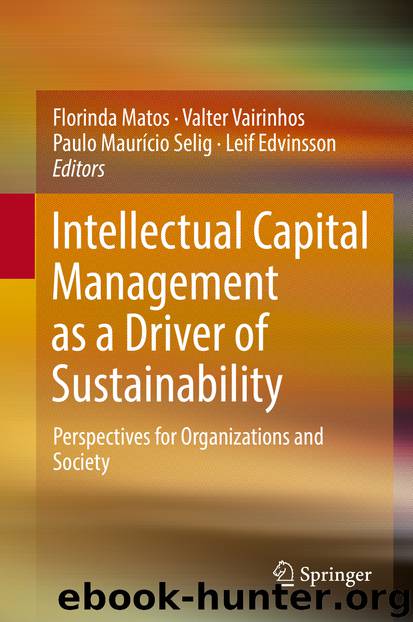
Author:Florinda Matos, Valter Vairinhos, Paulo Maurício Selig & Leif Edvinsson
Language: eng
Format: epub
Publisher: Springer International Publishing, Cham
Keywords
SustainabilityIntellectual capital managementEnvironmental, social, and economic sustainability practices
7.1 Introduction
This study is part of the field of investigation into Intellectual Capital Management (ICM), attempting to understand the relationship between ICM practices and sustainability-oriented activities in organizations. It starts from the assumption that development of ICM practices and routines is capable of supporting implementation of sustainability activities in organizations.
In this respect, understanding that studies within the intellectual capital theoretical approach have evolved considerably over recent years is vital, since the seminal studies by Bontis, Keow, and Richardson (2000), Edvinsson and Malone (1998), Stewart (1998) and Sveiby (1997). The concept of Intellectual Capital (IC) is of an intangible asset, which is intrinsic to the knowledge of all the sectors in an organization and which, when properly managed, is capable of providing competitive advantages to the company.
Recent contributions to the literature on ICM have emphasized its potential concerning social and environmental issues, redefining organizations’ contributions to society’s ecosystem. For example, Cavicchi and Vagnoni (2017) and Mertins and Orth (2012) analyze an integrated perspective on sustainability and ICM. These authors define sustainable intellectual capital as the sum of knowledge that contributes to implementation of sustainable development projects in organizations, within the social, economic, and environmental dimensions. Within this context, the research question that motivates this study is defined as: How do intellectual capital management practices support sustainability activities in organizations?
For these reasons, this study is based on an analysis of qualitative data and its objective is to investigate the sustainability activities of a Brazilian industrial firm and its ICM practices that lead to sustainability initiatives.
According to research by Cavicchi and Vagnoni (2017), evidence proves that ICM (of human, structural, and relational capital) can aid in implementation of sustainability projects, enabling organizations to achieve competitive advantages. Therefore, it is worth discussing practices that currently exist in different organizational realities that are capable of enhancing the implementation of actions focused on organizational sustainability. Empirical studies that address the relevance of ICG in the adoption of sustainable strategies are scarce and do not address the value of CI as a whole (Cavicchi & Vagnoni, 2017; De Leaniz & del Bosque, 2013; Mertins & Orth, 2012).
Thus, it appears that the investigation of ICM practices as well as its relationship with the actions of sustainability of organizations express themselves as relevant for scientific research in management. This study is intended to contribute furthermore to the theoretical ongoing discussion in previous studies by Cavicchi and Vagnoni (2017), De Leaniz and del Bosque (2013), Kianto, Andreeva, and Pavlov (2013) and Utama and Mirhard (2016) by presenting a set of practices related to the dimensions of ICM that can maximize sustainability. Thereby, a theoretical basis will be constructed to support the study.
The remainder of this chapter is structured as follows. Section 7.2 presents the discussion on IC management and IC dimensions: human, structural and relational. Section 7.3 presents a discussion on the contribution of ICM to the development of sustainability actions in organizations. Section 7.4 describes the methodology used to develop the research. Results are presented in Sect.
Download
This site does not store any files on its server. We only index and link to content provided by other sites. Please contact the content providers to delete copyright contents if any and email us, we'll remove relevant links or contents immediately.
International Integration of the Brazilian Economy by Elias C. Grivoyannis(111440)
The Radium Girls by Kate Moore(12106)
Turbulence by E. J. Noyes(8141)
Nudge - Improving Decisions about Health, Wealth, and Happiness by Thaler Sunstein(7769)
The Black Swan by Nassim Nicholas Taleb(7215)
Rich Dad Poor Dad by Robert T. Kiyosaki(6768)
Pioneering Portfolio Management by David F. Swensen(6350)
Man-made Catastrophes and Risk Information Concealment by Dmitry Chernov & Didier Sornette(6154)
Zero to One by Peter Thiel(5888)
Secrecy World by Jake Bernstein(4816)
Millionaire: The Philanderer, Gambler, and Duelist Who Invented Modern Finance by Janet Gleeson(4546)
The Age of Surveillance Capitalism by Shoshana Zuboff(4371)
Skin in the Game by Nassim Nicholas Taleb(4317)
The Money Culture by Michael Lewis(4271)
Bullshit Jobs by David Graeber(4261)
Skin in the Game: Hidden Asymmetries in Daily Life by Nassim Nicholas Taleb(4063)
The Dhandho Investor by Mohnish Pabrai(3834)
The Wisdom of Finance by Mihir Desai(3804)
Blockchain Basics by Daniel Drescher(3649)
